


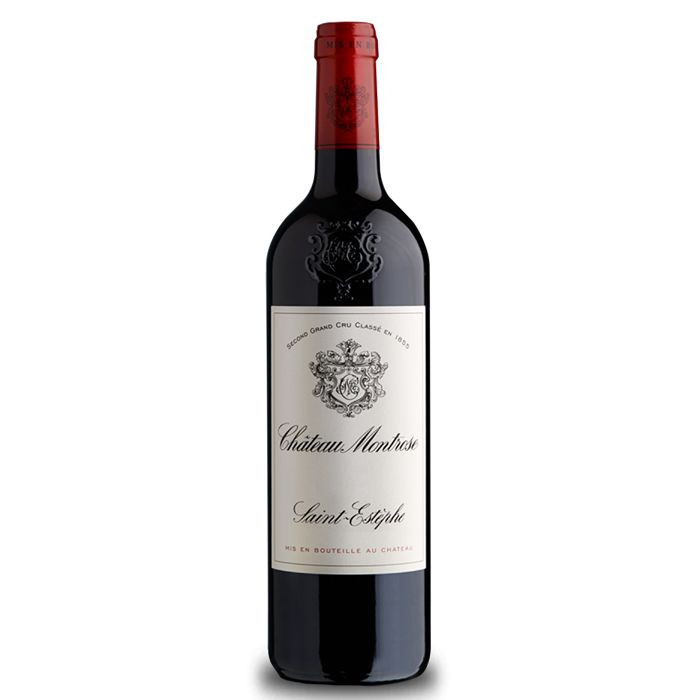
The best hand-picked grapes from a strict selection of plots are the origin of Château Montrose 2018, the grand vin of the century-old winery of the same name. An exceptional red wine that holds 98+ Parker points.
Consumption features
Serving temperature
General features
Type of wine
Region
Grape variety
2% Petit Verdot, 6% Cabernet Franc, 72% Cabernet Sauvignon, 20% Merlot
Type of barrel
New barrels at 60% French oak
Type of bottle
Bordeaux Bottle
Barrel aging time
18 months
Capacity (cl)
75
Alcohol content (% vol.)
14.5
General Information
Château Montrose 2018 is one of the great wines of the A.O.C. Saint-Estèphe, the largest appellation in Médoc. Located near the Gironde estuary, the 95-hectare vineyard, from which the grapes used to produce it are sourced, is characterized by its meticulous parceling, allowing for the utmost quality control.
After selecting the best parcels, Château Montrose carried out manual harvesting of the cabernet sauvignon, merlot, cabernet franc, and petit verdot clusters at their optimal ripeness. The tailor-made vinification was done in tanks of different sizes, tailored to each batch of selected grapes. The production process concluded with 18 months of aging in oak barrels, ultimately resulting in a fleshy red wine, intense in color, aromas, and flavor, with a long finish.
Founded in 1815, Montrose is one of the most important wineries in the A.O.C. Saint-Estèphe and, by extension, in Médoc. Since 1855, it holds the classification of Second Grand Cru Classé, the highest for wines under this controlled designation of origin. Today, the estate belongs to brothers Martin and Olivier Bouygues. Under their management, the bicentennial château has undergone significant improvements, including the construction of a new winery and the implementation of geothermal energy use across the entire estate.
Tasting notes
Deep dark red color.
Expressive and elegant on the nose, where we find, in a still glass, aromas of white flowers. Once the glass is swirled, more complex aromas of ripe black fruits, smoky and toasted notes appear.
Full-bodied attack marked by great aromatic richness. Clean, precise, elegant, and velvety palate. A very fine, well-defined, and balanced wine. Silky tannins and a very long finish with a touch of oak and licorice.
The winery
Winery
In the commune of Saint-Estèphe, just five kilometers north of Pauillac, in the northernmost area of the Médoc, and in a privileged location overlooking the great Gironde estuary, stands Château Montrose.
The history of this estate dates back to 1815, when Etienne Théodore Dumoulin, upon the death of his father, inherited the property and, convinced of its potential, decided to turn it into a vineyard, building all the necessary facilities for winemaking and production. Soon, the estate's red wines began to stand out for their quality. In 1855, the Bordeaux Wine Classification ranked them as a Second Grand Cru Classé, the highest quality distinction in the A.O.C. Saint-Estèphe, the appellation to which the château belongs.
From 1896 to 2006, the winery became part of the heritage of the Charmolue family. Under their management, Montrose experienced a golden age marked by stability and excellence, consolidating its reputation as one of the most important estates in the Médoc. This legacy has been upheld to this day by brothers Martin and Olivier Bouygues, the new owners of the estate. Under their leadership, the estate has entered the 21st century with the implementation of a spectacular project that includes the construction of a new winery, the introduction of geothermal energy, a strong commitment to environmental sustainability, and the preservation of the original 18th-century architectural ensemble.
All of this while maintaining the 95 hectares of splendid vineyards surrounding the château, perfectly divided into small plots, dominated by cabernet sauvignon, alongside the less prevalent merlot, cabernet franc, and petit verdot. These varieties are used to produce structured red wines with powerful tannins that embody the elegance and refinement of Bordeaux's Grand Cru Classé.
The history of this estate dates back to 1815, when Etienne Théodore Dumoulin, upon the death of his father, inherited the property and, convinced of its potential, decided to turn it into a vineyard, building all the necessary facilities for winemaking and production. Soon, the estate's red wines began to stand out for their quality. In 1855, the Bordeaux Wine Classification ranked them as a Second Grand Cru Classé, the highest quality distinction in the A.O.C. Saint-Estèphe, the appellation to which the château belongs.
From 1896 to 2006, the winery became part of the heritage of the Charmolue family. Under their management, Montrose experienced a golden age marked by stability and excellence, consolidating its reputation as one of the most important estates in the Médoc. This legacy has been upheld to this day by brothers Martin and Olivier Bouygues, the new owners of the estate. Under their leadership, the estate has entered the 21st century with the implementation of a spectacular project that includes the construction of a new winery, the introduction of geothermal energy, a strong commitment to environmental sustainability, and the preservation of the original 18th-century architectural ensemble.
All of this while maintaining the 95 hectares of splendid vineyards surrounding the château, perfectly divided into small plots, dominated by cabernet sauvignon, alongside the less prevalent merlot, cabernet franc, and petit verdot. These varieties are used to produce structured red wines with powerful tannins that embody the elegance and refinement of Bordeaux's Grand Cru Classé.