


Do you have any questions?
Monday to Friday from 9am to 20pm
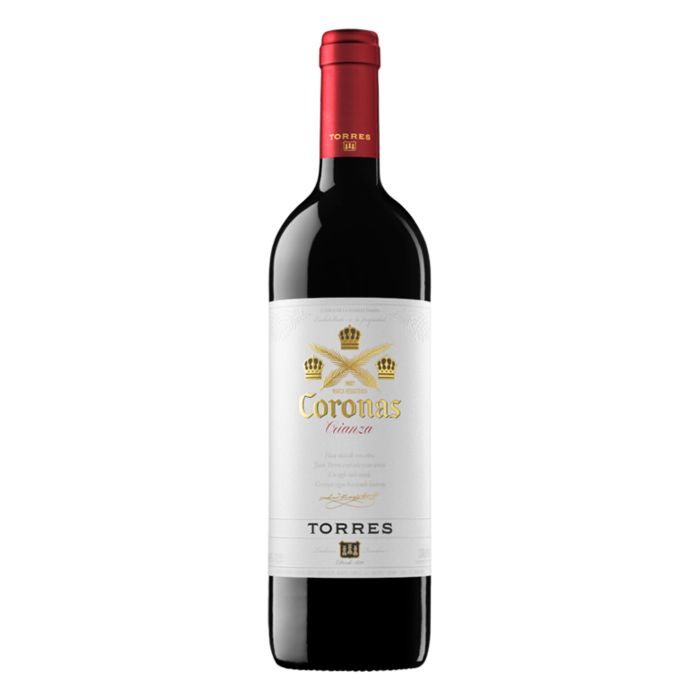
Coronas Crianza 2021 is the latest vintage on the market of one of the most historic reds in the Spanish wine scene. Made by the prestigious Familia Torres, from tempranillo grapes and a touch of cabernet sauvignon.
Consumption features
Serving temperature
Consumption time
General features
Type of wine
Region
Type of barrel
Used American and French oak barrels
Type of bottle
Bordeaux Bottle
Capacity (cl)
75
General Information
Familia Torres is a member of the Primum Familiae Vini, an association that includes twelve of the most prestigious centenary wine-making families in Europe. The Coronas brand, registered in 1907, is the first of the house. We present to you the latest edition of their Crianza: Coronas Crianza 2021, a blend of two noble varieties: tempranillo and cabernet sauvignon. A magnificent red wine under the D.O. Catalunya that rounded off its production with 12 months of aging in used French and American oak barrels.
Linked to the land for more than three centuries – the first references as winegrowers date back to 1678 –, Familia Torres has historically had wineries and vineyards in Penedès, where it originates, Conca de Barberà, Priorat, and Costers del Segre. Each generation has contributed to the development of the business and has passed on to the next the passion for wine culture and the importance of caring for the land and striving for excellence.
The fourth generation, with Miguel A. Torres, introduced the cultivation of cabernet sauvignon in Spain, while the fifth generation is currently focused on producing wines from unique vineyards and historical estates and recovering ancestral varieties. Familia Torres is also present with its own vineyards and wineries in the main Spanish wine regions – Rioja, Ribera del Duero, Rueda, and Rías Baixas –, as well as in Chile and California. Familia Torres owns 1800 hectares of vineyards in Catalunya, 850 of which are certified organic by the CCPAE.
Creators' opinion
Dark cherry color with garnet hues. Intense aromas of black and forest fruits, with subtle vegetal and spicy notes. Harmonious on the palate, with medium body and soft tannins.
The winery

Since their beginnings as winemakers in 1870, the Familia Torres has combined tradition and innovation in the production of prestigious wines and brandies, always working with the utmost respect for the environment. Linked to the land for more than three centuries – with the first references as winegrowers dating back to 1559 – they have historically had wineries and vineyards in Penedès, where they originate, as well as in Conca de Barberà, Priorat, and Costers del Segre. Each generation has contributed to the development of the business and passed on to the next the passion for wine culture, the importance of caring for the land, and the pursuit of excellence.
The fourth generation, led by Miguel A. Torres, introduced the cultivation of cabernet sauvignon in Spain, creating 'Mas la Plana' in 1970, while the fifth generation today focuses on producing wines from unique vineyards and historic estates, as well as recovering ancestral Catalan grape varieties. This project allows for the recovery of viticultural heritage and could become a future solution to climate change due to the ability of these varieties to withstand high temperatures and drought. Additionally, Familia Torres contributes to minimizing the consequences by reducing their CO2 emissions, from the vineyard to the consumer, through the use of renewable energy, sustainable vehicles, energy efficiency measures, reducing bottle weight, regenerative viticulture, reforestation, and more. Their goal is to become a zero net emissions winery by 2040.
Familia Torres is also present with its own vineyards and wineries in Spain's main wine regions – Rioja, Ribera del Duero, Rueda, and Rías Baixas – as well as in Chile and California. They are members of Primum Familiae Vini, an association that brings together twelve of Europe's most prestigious centenary wine-producing families. Familia Torres owns more than 1,100 hectares of vineyards in Spain, 1,000 of which are located in Catalunya and certified as organic by the CCPAE. Most of the vineyards are cultivated using regenerative viticulture techniques.