

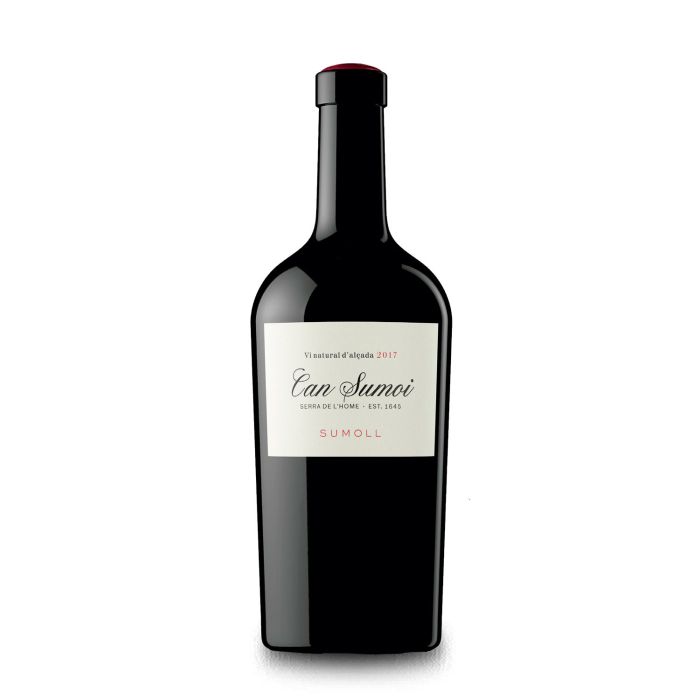
Can Sumoi Garnatxa Sumoll 2023 is one of the high-altitude natural wines from Raventós i Blanc. The great Catalan winery is committed to productions stripped of artifices but wrapped in tradition, and presents Can Sumoi, its new label in the Tarragona lands of Bajo Penedès.
Consumption features
Serving temperature
General features
Type of wine
Region
Grape variety
50% Garnacha tinta, 50% Sumoll Tinto
Type of barrel
Chestnut boots
Type of bottle
Truncated Conical Bottle
Barrel aging time
9 months (20% of the wine)
Capacity (cl)
75
Total acidity (g/l)
4.8
Volatile acidity (g/l)
0.34
Sugar
>0.5
pH
3.46
Alcohol content (% vol.)
13.4
General Information
2012 marked a turning point for Raventós i Blanc. The Catalan giant left the D.O. Cava to begin a new chapter. The momentum of change led the Raventós family to embark on other projects, and Can Sumoi is undoubtedly one of the most interesting. Among the wines produced under this brand, Can Sumoi Garnatxa Sumoll 2023 is an intriguing red wine featuring garnacha, alongside a grape that was on the verge of disappearing in this area of the Bajo Penedès.
Due to its fresh acidity, meatiness, and reminiscent of sweet red fruits, many have described the sumoll as “the Mediterranean pinot noir.” Currently, this variety is experiencing a certain resurgence thanks to wineries and winemakers committed to recovering the traditions and native grapes of the region. This is the case with Can Sumoi. In producing Can Sumoi Garnatxa Sumoll 2023, the winery selected the best fruits cultivated in its namesake estate, a biodynamic farm dating back to 1645, with 30 hectares of vineyard, located at 600 meters altitude in the Tarragona municipality of El Montmell, at the foot of the Sierra de 'l’Home.
Minimal intervention in viticulture and winemaking is one of the hallmarks of Can Sumoi. To produce Can Sumoi Sumoll, the fruits underwent destemming and crushing in an inert atmosphere, leading to spontaneous alcoholic fermentation in stainless steel tanks at a temperature between 22 and 26 ºC. This process lasted 14 days. 80% of the wine rests for 9 months in tanks, while the remaining 20% does so in chestnut barrels. An additional three months of rounding in the bottle result in a natural wine, an expression of a unique terroir, that surprises with its authenticity.
The winery
Can Sumoi is the new winery from Raventós i Blanc, exclusively dedicated to the production of natural wines. Born from the growing passion of Pepe Raventós and Francesc Escala for this type of winemaking, the estate, which also gives its name to the project, is located in El Montmell, in the Bajo Penedés, at the foot of the Serra de 'l’Home, in a setting nestled at 600 meters above sea level.
Coinciding with their departure from the D.O. Cava in 2012, the Raventós family discovered this 400-hectare property, which had housed a biodynamic farm since 1645, and chose it to produce their high-altitude natural wines. The raw material comes from 30 hectares of vineyards, planted with the local varieties parellada, xarel·lo, and sumoll, on mineral soils with sediments and marine fossils dating back 113 million years.
In this privileged environment, Pepe Raventós aims to go further. The Catalan winemaker is firmly committed to biodynamic viticulture and naked wines, crafted according to rural traditions, reflecting their origin, without any enological additives.
Coinciding with their departure from the D.O. Cava in 2012, the Raventós family discovered this 400-hectare property, which had housed a biodynamic farm since 1645, and chose it to produce their high-altitude natural wines. The raw material comes from 30 hectares of vineyards, planted with the local varieties parellada, xarel·lo, and sumoll, on mineral soils with sediments and marine fossils dating back 113 million years.
In this privileged environment, Pepe Raventós aims to go further. The Catalan winemaker is firmly committed to biodynamic viticulture and naked wines, crafted according to rural traditions, reflecting their origin, without any enological additives.