


Do you have any questions?
Monday to Friday from 9am to 20pm

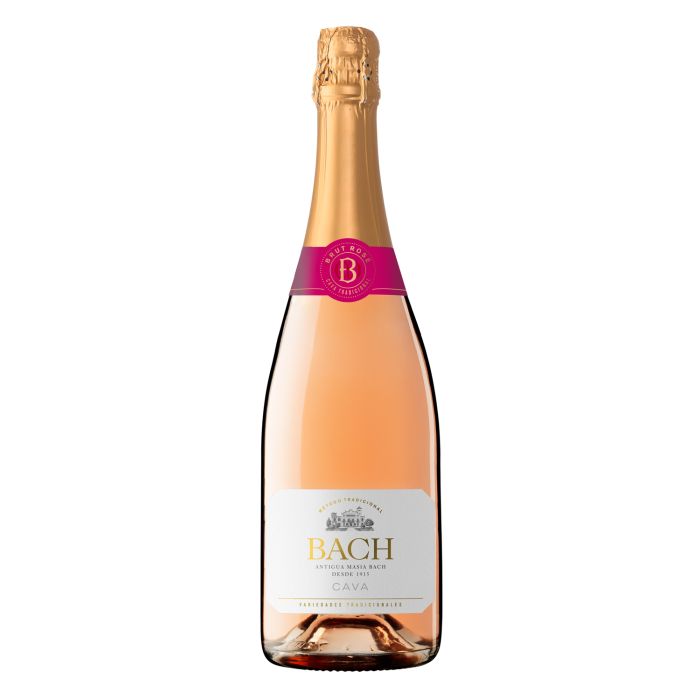
Cava Bach Rosé Brut is an extremely enticing Cava that’s visually appealing and will win you over with its flavours. The combination of Monastrell, Garnacha and Pinot Noir gives it an attractive pinkish colour and delicious aromas of ripe red fruit. This Cava is notable for its fascinating balance, smoothness on the palate and pleasant expressiveness – qualities that make it a perfect accompaniment to all kinds of appetisers, smoked fish, mild-flavoured deli meats, fish and seafood
Consumption features
Serving temperature
General features
Region
Grape variety
40% Monastrell, 20% Pinot Noir, 40% Garnacha tinta
Type of bottle
Champenoise Bottle
Capacity (cl)
75
Total acidity (g/l)
6-8
Sugar
8-10
Alcohol content (% vol.)
11.5
General Information
To make Cava Bach Rosé Brut the musts were carefully fermented at a low temperature (below 20ºC). After being blended, the wines were matured in the bottle in contact with their yeasts until disgorgement. The liqueur d’expedition was then added in accordance with the traditional method of making Cava. The process ended with 9 months in the bottle to lend the Cava more complex aromas of nuts and raisins, turning it into a much more attractive and interesting rosé.
The winery Masía Bach has a long tradition of winemaking. It dates back to 1915, when it was established in Sant Esteve Sesrovires in Barcelona, but it really took off following the 1929 Barcelona World’s Fair and the successful sale of its first bottles. Since then the winery has carried on producing wines and Cavas full of originality, quality and personality.
This Brut Rosé belonging to the D.O. Cava is suitable for any occasion thanks to its balanced and pleasant palate. It’s perfect with all kinds of appetisers, smoked fish, mild-flavoured deli meats, fish and seafood.
Tasting notes
Pale pink with medium-high pigmentation. It’s notable for its great fizz and light mousse.
Pleasant aromas of ripe red fruits (strawberry, cherry) in the nose, with slight touches of yeast, followed by complex aromas of nuts and raisins typical of mature Cava.
Balanced, smooth and pleasant on the palate.
The winery
In 1915, the brothers Bach i Escopet, Pere and Ramón, moved to Sant Esteve Sesrovires from Barcelona and acquired an 18th-century estate called Can Estrada. Thanks to the profits obtained from the cotton trade, the brothers were able to invest in setting up the winery, which gradually grew with the purchase of new estates, reaching a total area of 365 hectares. The 1920 harvest, based on Xarello and Macabeo, marked the debut of Bach.
The Spanish Civil War disrupted part of the splendor achieved by Bach in the 1920s and had tragic consequences for the family: Ramón died, and his brother Pere, although he survived the conflict, was deeply affected by its memory. A few years later, in 1942, he decided to sell the estate. In the following years, Bach had several owners until, in 1975, the Raventós family acquired the estate and integrated Bach into their group of wineries.