Chile is South America’s largest wine producer and the world’s fourth largest exporter, surpassed only by European countries such as France, Spain and Italy. With a wine-growing area of around 130,000 hectares, it’s become a unique producer of excellent quality wines thanks to its geographical characteristics, Mediterranean climate and advanced technology. In fact, the Chilean wine industry has grown steadily in recent decades, almost tripling its production since the late 1990s.
Chile boasts an enormous variety of terroirs, which yield wines with different profiles. It’s also one of the few places in the world not to have been affected by the phylloxera pest, meaning it has a large number of ungrafted, century-old vines.
Although the first vineyards cultivated in Chile were planted by Spanish settlers, the influence of French winemaking and grape varieties since the end of the last century has resulted in a wine map dominated by French varieties.
The Central Valley is the wine-growing heart of the country. It accounts for more than 80% of Chile’s wine production and stretches from 80 km north of Santiago (the capital) to more than 240 km in the south. The Central Valley is influenced by three features: the Coastal Range, the Intermediate Depression and the Andes mountains, which give rise to a wide variety of soils and climates. The coastal area is very humid with little temperature variation in the summer (between 15 and 18°C), whereas closer to the Andes the difference between day and night can exceed 20 degrees, with temperatures reaching as high as 35°C.
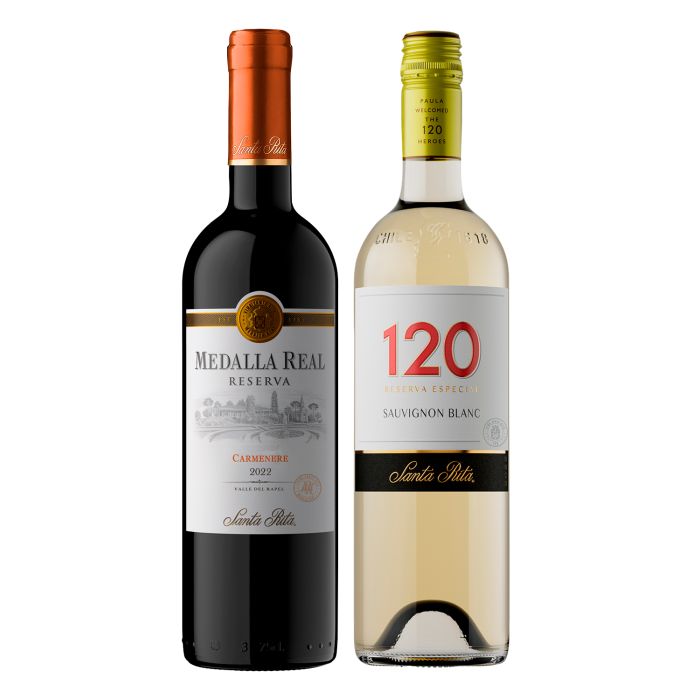
The wines in this selection are made by Santa Rita, a winery founded in 1880 that’s something of an institution in Chile and one of the companies that dominates the export market.
Medalla Real Reserva 2022 belongs to its high-end range. The backbone of this wine is the Carmenere grape, which accounts for 85% of the blend, enhanced by 15% Syrah; and it’s been aged for 8 months in American and French oak. Although Cabernet Sauvignon is the most widely grown grape in Chile, Carmenere, another French variety, is arguably the most iconic. The grapes were cultivated in the Rapel Valley, about 100 kilometres south of Santiago (in the Central Valley), an area with an ideal climate for wine production as there’s no spring frost and the summers are very warm. On the nose, it displays aromas of ripe black fruits, together with resiny and chocolate notes. Good structure on the palate, supple, with soft, elegant tannins and a long, fresh finish.
To complete the selection, we’ve chosen a white wine made from another French grape, Sauvignon Blanc, which, together with Chardonnay, is the most widely grown white variety. 120 Reserva Especial Sauvignon Blanc 2023 has exuberant aromas combining fruity and citrus notes along with subtle vegetal hints. It’s smooth on the palate, displaying good acidity with touches of lime, making it fresh and highly drinkable.