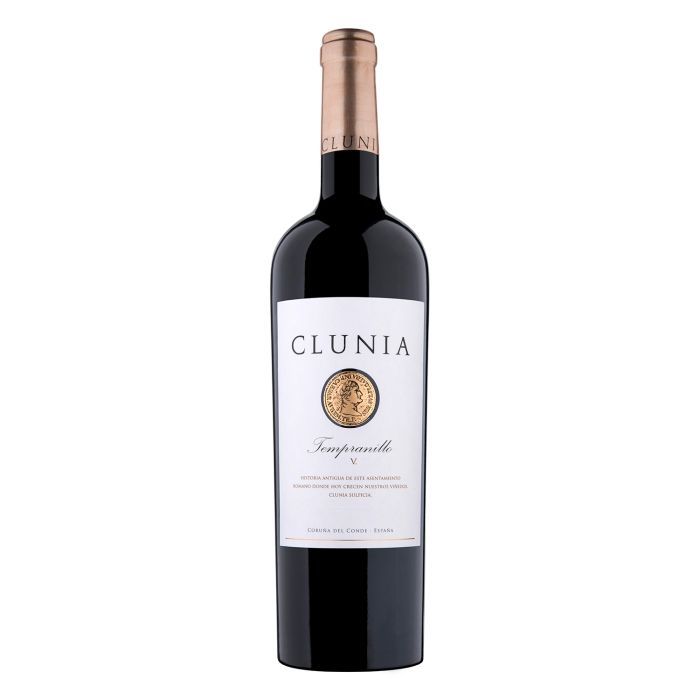
A Tempranillo of exceptional quality that has won over the critics
Clunia Tempranillo 2018 is a fresh and intense red born at 950 metres above sea level that has received 90 points or more in several of the most prestigious international wine publications.
Clunia Tempranillo 2018 is produced entirely from Tempranillo grapes, and does so with a very clear aim: to capture the best from a high-altitude estate, with a defined identity and no unnecessary embellishments.
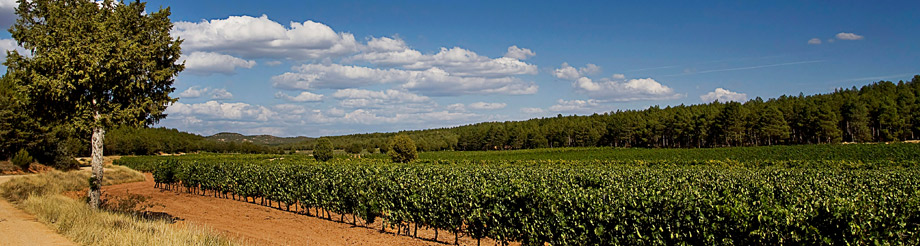
The grapes come from El Gerbal, at 950 metres above sea level, where the north-westerly wind helps keep the vineyard airy and protected. The vineyard is surrounded by pine forests and sits on calcareous-clay soils with the presence of sands and clays, in an extreme continental climate. The harvest is manual, with triple selection, and the grapes undergo a semi-freezing process that aims to refine aromatic extraction. Afterwards, the wine matures for 12 months in French oak barrels.
Behind it is Clunia, in Coruña del Conde, a winery closely tied to this landscape of high-altitude vineyards and limited production. Its project looks to the origin with a precise philosophy: to work each plot with care so that the land speaks without noise. That is why Clunia Tempranillo 2018 conveys a serious, direct and well-defined personality. The critics have fallen at the feet of this single-varietal, as demonstrated by 93 points from Guía Peñín, 92 from James Suckling, or 90 from Decanter and the International Wine & Spirit Competition.
Consumption features
Pairing
Clunia Tempranillo 2018 stands out for its ripe red fruit profile and its soft tannins, making it ideal to accompany judiones de la granja or patatas a la importancia.
Clunia Tempranillo 2018 was hand-harvested in small 10 kg baskets, with a triple selection of the fruit in the vineyard, on the sorting belts and vibrating tables. The grapes, 100% Tempranillo, arrived at the winery after a careful process that even included partial freezing to promote aroma extraction.
Winemaking
Clunia Tempranillo 2018 was worked in the winery with a very precise cold entry: a pre-fermentative maceration at 4 °C for between 24 and 48 hours, designed to protect the aromatic expression before fermentation.
Subsequently, the wine underwent alcoholic fermentation in stainless steel tanks with yeasts previously selected in the vineyard, between 7 and 10 days, before prolonging the contact with the skins in a post-fermentative maceration of 13 days, culminating in a total maceration period of 21 days. The malolactic fermentation took place in barrels, with batonage on its lees, thus refining the texture and contributing greater integration to the whole.
The result is a wine made to concentrate without losing freshness, with careful extraction and a clean aromatic definition, capable of sustaining the wine's fruity character and its balanced mouthfeel.
Aging
Has been aged for 12 months in French oak barrels.
Bottling
Limited edition of 10,200 bottles for the 2018 harvest.
Vineyard
Description
Clunia Tempranillo 2018 is grown on the El Gerbal estate, a vineyard planted in 1999 at 950 metres above sea level, where the vines benefit from the north-westerly wind and grow surrounded by pine woods. The calcareous-clay soils, with a high presence of sands and clays, compel the vine to explore a rocky subsoil that concentrates the grape's character.
Age
The vines were planted in 1999.
Climate
The climate is extreme continental, with cold winters, hot summers, a large diurnal temperature range, abundant sunshine and scarce rainfall during ripening, conditions that favour a precise harvest and a ripe, well-defined expression.
Viticulture
Clunia Tempranillo 2018 pcomes from the El Gerbal estate, at 950 metres above sea level, where the vines of Tempranillo grow protected and ventilated by the northwest wind, surrounded by pine forests and on calcareous-clay soils with an abundance of sands and clays.
Tasting notes
View
Deep ruby colour with good depth, clean and bright.
Nose
Intense and very defined nose. Aromas of red fruits such as red currants, Morello cherry and plums stand out, with a cassis background that adds depth and character. Barrel ageing integrates elegantly and adds notes of vanilla, cocoa and sweet spices, while fresh balsamic nuances and hints of eucalyptus appear on the finish.
Mouth
The palate is round, balanced and persistent. On tasting, it comes across as pleasant and straightforward, with the weight of the fruit very much in evidence and soft tannins that provide a polished texture. Barrel ageing integrates naturally and leaves a harmonious impression, with good persistence and a finish that prolongs its fruity character.
With a small production of around 40,000 bottles, Clunia is the ‘pampered’ winery of the Grupo Príncipe de Viana, which also owns the renowned wineries Príncipe de Viana, Rioja Vega, and Albret.
Founded in 2008 in the image of the châteaux, Clunia is located in Coruña del Conde, a small municipality in Burgos at an altitude of around 1,000 meters above sea level. On its 72-hectare estate, it cultivates the red grape varieties tempranillo, malbec, and syrah, as well as the white albillo. Its vineyards began to be planted in the nineties, when very few believed in the potential of this unique terroir.
The altitude of the vineyards, ranging from 900 to almost 1,100 meters above sea level, provides the area with an extreme continental climate, with significant temperature differences between day and night during the ripening period, which enhances the expressiveness of the clusters. Vines rooted in a limestone soil, with the presence of clays and sands, also grant the vineyard a unique singularity.