


Do you have any questions?
Monday to Friday from 9am to 20pm
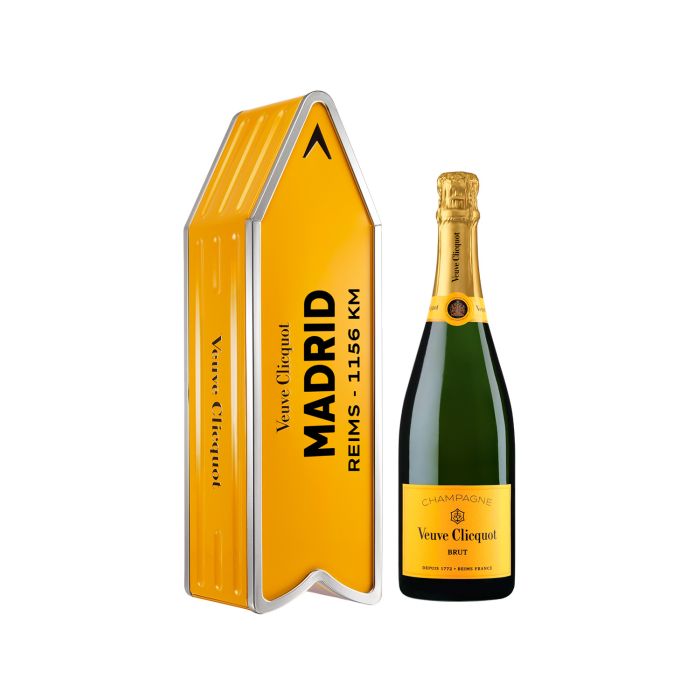
In 1805, at just 27 years old, Madame Clicquot took over the family winery, transforming the world of champagne with bold ideas and techniques that still set the standard in the industry today. More than 140 years later, Veuve Clicquot Yellow Label remains a global benchmark, a symbol of elegance and character.
This cuvée masterfully expresses the art of blending of the Maison, achieving a harmonious balance between aromatic intensity, vibrant freshness, and a silky texture that defines its unmistakable style.
The bottle is presented in the limited edition Arrow Madrid case, a modern reinterpretation of traffic signs that symbolically points towards the Spanish capital, indicating the distance separating it from the Veuve Clicquot cellars in Reims. Made from recyclable tin and free of plastic, this case not only stands out for its iconic and sustainable design but also keeps the champagne cold for at least an hour, making it an ideal piece for gifting or collecting.
General features
Region
Grape variety
Type of bottle
Champenoise Bottle
Capacity (cl)
75
Creators' opinion
It presents a straw yellow tone accompanied by fine and persistent bubbles.
On the nose, it is expressive and pleasant, with aromas reminiscent of citrus fruits such as mandarin and grapefruit, along with notes of pastry like brioche and subtle hints of dried fruit. Delicate mineral touches can also be perceived.
On the palate, it stands out for its well-balanced freshness and pronounced fruity structure. The finish is especially creamy, leaving a smooth and elegant sensation.
The winery
Nicole Barbe Ponsardin, the widow (in French ‘veuve’) of Clicquot, had to take charge in 1805, at the age of 27, of the flourishing business her husband managed: the champagne house François Clicquot, a textile entrepreneur who founded his winery in the French region of Champagne in 1772. The widow Clicquot was a pioneer in a male-dominated world, taking over the business and leading the winery. She prevented the disappearance of the winery, which was the fate of most after the death of the man who ran them, and steered the family business towards success. She continued the path of innovation set by her husband’s father, who in 1775 had created the first rosé champagne in history. Under Nicole’s leadership, in 1810 the house was renamed Veuve Clicquot Ponsardin, and the first vintage champagne of the house was produced. The German Antoine Müller joined as cellar master, refining the méthode champenoise and revolutionizing the Champagne production market by introducing innovations such as remuage (to naturally clarify champagne, achieving the clear and brilliant color it boasts today); or the technique of storing bottles in wooden racks with the neck down at a 45-degree angle and daily rotations (so that sediments settle in the neck of the bottle and can later be removed through disgorgement). In 1866, Nicole Barbe Ponsardin died at the age of 89. She will always be remembered as the grande dame of Champagne, a name now given to the winery’s high-end wine. The prestige of this house has continued to grow, and it is now one of the most popular Champagne houses, with its unmistakable yellow-orange label and its flagship cuvée La Grande Dame, one of the most complex and refined champagnes. Now part of the luxury brand group LVMH, its wide distribution makes it easy to find its wines on the market. Veuve Clicquot controls around 400 hectares of vineyards, located between the Montagne de Reims and the Côte des Blancs, covering 25% of the winery’s needs. The rest of the grapes are purchased from winegrowers with whom the house has long-term contracts. Its Brut Yellow Label is the most well-known brand, accounting for the majority of its production. It is a champagne made from a blend of grapes from fifty different estates and is in high international demand