

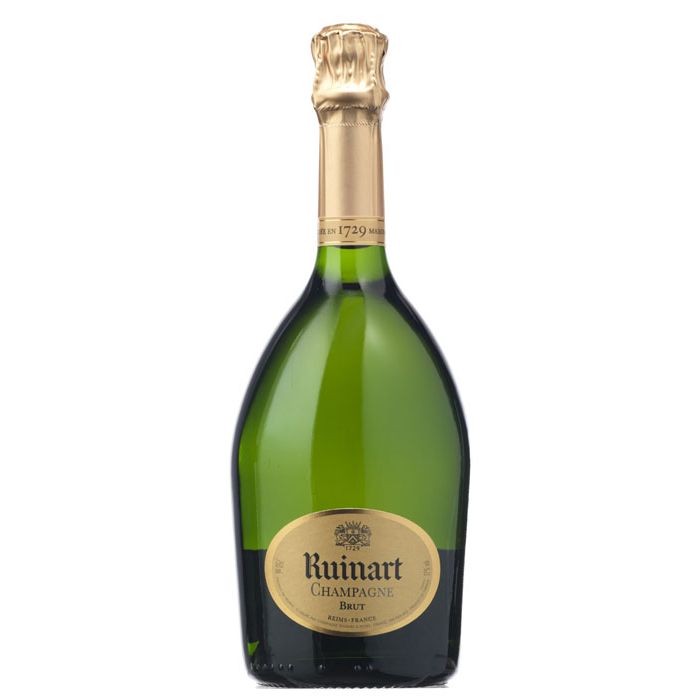
R de Ruinart Brut
The fresh personality of the first ‘maison’ in history

Do you have any questions?
Monday to Friday from 9am to 20pm
Ruinart was the first ‘maison’ of Champagne and today enjoys an enviable position. We present R de Ruinart Brut, the only champagne of the house that incorporates the pinot meunier grape in the cuvée. With three years of aging, it is delicate and fruity on the nose, with notes of pear and dried fruits. The finish displays notes of white flowers, Viennese pastries, and buttery brioche.
Type of wine
Region
Grape variety
Type of bottle
Champenoise Bottle
Capacity (cl)
75
The Ruinart house is the oldest in the Champagne region, a winery renowned for producing fragrant, fresh, and elegant champagnes. R de Ruinart Brut is a delightful ‘coupage’ of pinot noir, chardonnay, and pinot meunier, made with grapes mostly from the vineyards of Côtes des Blancs and the Marne Valley.
Hand harvesting and fermentation in temperature-controlled stainless steel tanks. Complete malolactic fermentation. The final coupage includes 20 to 25% of Reserve wines aged 2 to 3 years. It undergoes maturation in the bottle for 3 to 4 years in the Ruinart cellars.
Nicolas Ruinart founded the Ruinart House in 1729, a winery considered the oldest in Champagne. Over nearly three centuries, the Ruinart descendants have continued to develop the excellence of this “maison.” Their wine range highlights the chardonnay grape, the base for both their non-vintage ‘cuvees’ and the exceptional long-aged ‘millesimés.’ Their historic vineyard consists of 17 hectares of chardonnay in the northern part of the Montagne de Reims. It is the Grand Cru Sillery, a giant estate for the region's standards, near Mailly and Verzènay. They also own some plots in the Côte des Blancs.
R de Ruinart (A.O.C. Champagne) displays a delicate and fruity nose, with dominant aromas of fresh white pear, almonds, and hazelnuts. The finish reveals notes of white flowers, pastry, and brioche.
Ruinart Brut is a wine with chestnut, yellow, and golden reflections. It reveals, at first, subtle fruity notes of reinette apples and apricots, along with fresh almonds and hazelnuts. The hints of elderflower and coriander seeds add a touch of complexity. Secondly, it offers intense aromas of brioche and biscuit. On the palate, it shows sweet notes of fruits, plum tart, and ripe stone fruits. An enveloping palate with a harmonious and persistent roundness. The finish reveals the distinctive freshness of chardonnay.
The house Ruinart is the oldest in Champagne, emphasizing finesse and elegance as its characteristic traits. The philosopher and theologian Dom Thierry Ruinart (1657-1709) studied at the abbey of Saint-Germain-des-Prés. A descendant of an ancient family from Reims owning vineyards, he inspired his brother Nicolas by speaking to him about the growing interest in Champagne wine at the French court. Thus, Thierry Ruinart is considered the visionary behind the founder of the first Champagne house. It was Nicolas Ruinart's son, also named Nicolas, who on September 1, 1729, founded the Maison Ruinart. It is regarded as the oldest producing house, although Gosset also claims this title, as since 1584 Ruinart had been producing wines, though not sparkling ones, but still wines.
For nearly three centuries, the Ruinart descendants have continued to develop the excellence and recognition of the "Ruinart taste" worldwide. Their devotion to craftsmanship and constant pursuit of quality, purity, and elegance have guided their destiny. The Champagne region is planted with three types of grape varieties that produce different wines depending on the soil where they grow. Chardonnay, Ruinart's favorite and the rarest, produces wines of great finesse and unparalleled elegance when grown on the chalky soils of the Côte des Blancs, a land tied to the Ruinart saga for several generations; or wines of great body and strength when grown on the Montagne de Reims.