


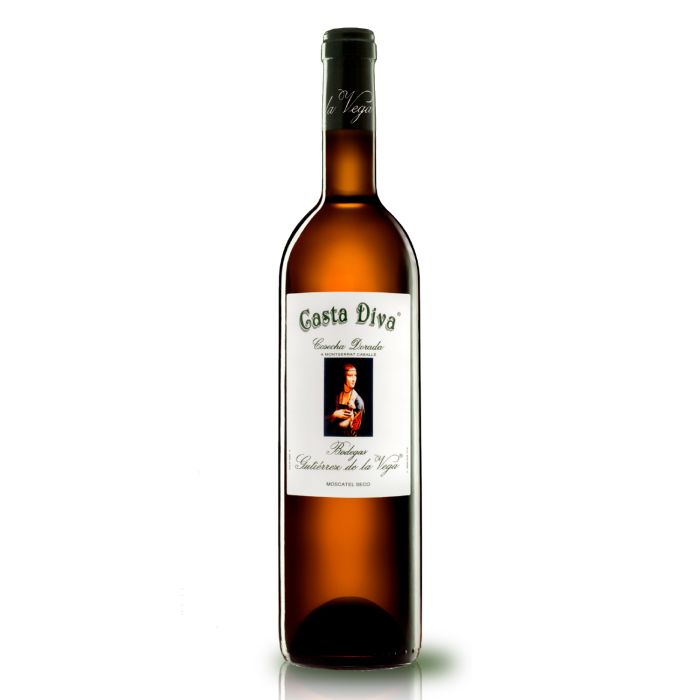
Casta Diva Cosecha Dorada 2022 is a dry white wine made entirely from Moscatel Romano fruits matured in 40-year-old clay-limestone vineyards located in the Jalón Valley. It has a suggestive perfume of white flowers, apricot, citrus, dry bay leaf, and a lively aniseed touch. On the palate, it is surprisingly dry, extraordinary as an aperitif and as a companion to saffron cuisine. Don't miss the first dry Moscatel produced in Spain.
Consumption features
Serving temperature
Consumption time
General features
General Information
Traditionally, in Marina Alta, Roman Muscat was used both for the production of raisins and fortified sweet wines. Felipe Gutiérrez de la Vega came up with the idea in 1987 to use this variety to create a dry, fresh, and aromatic white wine, ideal for the characteristic rice dishes of the area. An example of this is the fantastic Casta Diva Cosecha Dorada 2022.
Gutiérrez de la Vega is one of the most symbolic wineries in Alicante. It was founded in the 1970s by Felipe Gutiérrez and his wife Pilar Sapena, and since 2006, it has been run by their daughter Violeta. The winery is located in the Jalón Valley, one of the areas in Marina Alta that produces wines from three native varieties that the winery has sought to revive: Monastrell, Muscat of Alexandria, and Garnacha.
After the work in the vineyard, the harvest was manually picked and taken to the winery, where it was directly pressed and fermented for 15 days in a stainless steel tank. After malolactic fermentation, the wine was aged on lees for 5 months in stainless steel tanks and lightly filtered before bottling and marketing. With a production of 10,000 bottles, this Casta Diva Cosecha Dorada 2022 pairs ideally with products with a certain salty nuance, where the sweetness of the Muscat is recovered for a dry wine, as well as preparations with floral touches and saffron cuisine (rice and noodles).
Tasting notes
Casta Diva Cosecha Dorada displays a pale lemon-yellow color with greenish reflections, clean and bright.
Mainly floral nose (rose, almond blossom, jasmine) with a touch of lemon verbena over a slightly musky background. Citrus notes and hints of aniseed appear.
On the palate, it is fresh from start to finish, direct and slightly airy with a saline finish.
The winery
Winery
In the 1970s, the couple formed by Felipe Gutiérrez de la Vega and his wife Pilar Sapena settled in a country house in Jávea to work on the old family vineyards. However, it was in 1982 when the winery was moved to an olive mill in Parcent, in the Marina Alta region of Alicante, to market those wines that gradually gained recognition both nationally and internationally, which allowed them, a decade later, to inaugurate the current winery, more modern and functional, adapted to the times.
They consider their philosophy to be centered on creating a family wine, as they are involved in all the winemaking processes (from working in the fields to designing the label).
It is worth highlighting the great work of Felipe Gutiérrez de la Vega in the recovery of traditional wines from the area, especially sweet muscat wines. The founder of the winery is a great lover of music, opera, and literature, and has drawn inspiration from classical works to name his wines. Examples of this are the wines under the name Casta Diva (the title of Bellini's opera) where the muscat grape is the true protagonist. These sweet wines are considered among the best in our country. Among them, we can mention Fondillón Casta Diva 1987 or Casta Diva Cosecha Miel.
He also pays homage to other figures of literature and contemporary music with wines named “Ulises” (Joyce), “Rojo y Negro” (Stendhal), “Príncipe de Salinas” (the prince from the novel “The Leopard” by Lampedusa), “Tambourine” (Dylan), or “Viña Alejandría” (Cavafy), among others.
One of the characteristics of this winery is that it currently produces its wines from three main and native varieties: monastrell, moscatel de alejandría, and garnacha.